
The 8 Best Enterprise Imaging Platforms for Zero-Footprint Diagnostic Viewing
Many radiology teams run into slow image retrieval when switching between facilities or desktops, forcing them to hunt for USB drives or remote logins. This friction multiplies across multi-site groups that need instant access without local installs. Most platforms still demand client software or VPN tunnels that delay urgent reads.
By the end of this article you will see which nine vendors support true browser-based viewing, which ones bundle cloud PACS, and the exact criteria that separate Medicai from the other eight listed. You will also walk away with a short checklist to match your workflow to the right option.
What to Look For in Enterprise Imaging Platforms for Zero-Footprint Diagnostic Viewing
Enterprise imaging platforms must deliver rapid, secure, browser-based access to DICOM studies while maintaining diagnostic quality across specialties and network conditions.
Zero-footprint viewer architecture requires no local install and supports HTML5. A radiologist can open chest CTs directly in a web browser during a remote reading session.
Lossless compression plus adaptive streaming maintains diagnostic quality on bandwidth as low as 5 Mbps. A cardiologist reviews a cardiac MRI study from a rural clinic without delays.
DICOMweb and WADO-RS support plus HL7/FHIR EMR integration ensures studies appear automatically in the patient record.
Multi-modality 3D reconstruction and hanging protocols for radiology, cardiology, and oncology allow an oncologist to align PET and CT slices during tumor board review.
Granular role-based access controls and audit logs track every view, export, and annotation across the care team.
Vendor-neutral archive capability for long-term retention stores imaging studies from multiple specialties in a single repository.
Mobile and tablet support with touch-optimized interfaces lets an orthopedic surgeon scroll through knee MRIs on an iPad during rounds.
1. Medicai - Best Overall
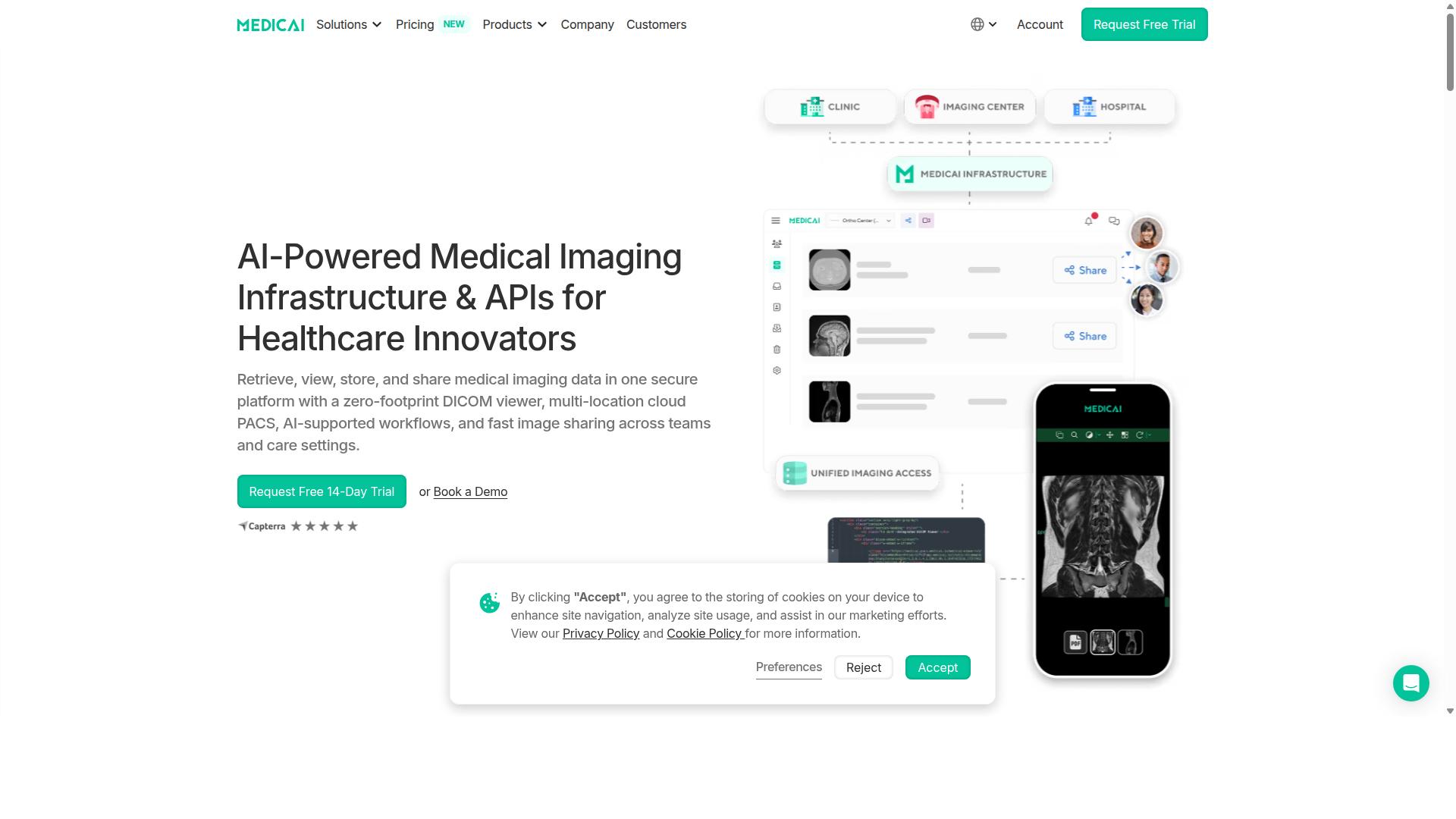
Medicai earns the top rank for its fully cloud-hosted, zero-footprint DICOM viewer that combines enterprise-grade storage, exchange, and collaboration in a single HIPAA/GDPR-compliant platform.
The three bundled modules address the full imaging lifecycle from acquisition to review. Connect & Retrieve handles inbound study ingestion through the Medical Imaging Uploader and DICOM Gateway.
Store & Manage includes Cloud PACS, Vendor Neutral Archive, and Patient Case Management features. Access, View & Collaborate offers the DICOM Viewer, Doctor Imaging Portal, and Structured Reporting for Radiology capabilities.
Medicai processes 1 M+ studies per year with 1.7 M+ studies currently archived across its enterprise imaging infrastructure.
Zero-Footprint DICOM Viewer & Cloud PACS Capabilities
Its thin-client viewer renders multi-modality studies (CT, MR, PET-CT, US, MG, XR) directly in the browser without plugins while supporting 3D MPR, MIP, and volumetric rendering.
The Medical Imaging Uploader and DICOM Gateway manage inbound study ingestion from external facilities and modalities. These tools work together to standardize incoming data formats before routing them into the core system.
Cloud PACS and Vendor Neutral Archive provide scalable storage that grows with institutional needs. The built-in Patient Case Management workspace lets multidisciplinary teams annotate and co-author reports in real time.
This architecture supports radiology workflow requirements while maintaining image quality across different network conditions. The platform enables image distribution to specialists without requiring local software installations.
Security Compliance & Global Availability
The platform is both HIPAA and GDPR compliant, FDA-cleared (US) and CEE-cleared (Europe), and accessible worldwide via any modern browser.
Medicai runs on Microsoft Azure, Amazon AWS, and Hetzner infrastructure with daily encrypted backups and disaster-recovery SLA. This multi-cloud approach ensures data redundancy and availability across different geographic regions.
The system supports remote reading for teleradiology workflows across multiple time zones. Healthcare providers can access studies from any location with internet connectivity while maintaining compliance standards.
Global availability enables cross-border collaboration between radiologists and referring physicians. The infrastructure meets enterprise imaging requirements for both academic medical centers and regional health systems.
2. Intelerad

Intelerad offers an on-premise and hybrid-cloud PACS with a downloadable diagnostic viewer that some hospitals may find heavier than zero-footprint alternatives.
Deployment models vary between fully hosted and customer-managed environments. Hospitals choose based on data governance needs and existing infrastructure investments.
Pricing transparency remains limited across public materials. Organizations typically request custom quotes during evaluation cycles.
Enterprise imaging platforms support DICOM workloads and connect with vendor-neutral archives. This architecture enables secure sharing across healthcare networks.
Multi-specialty imaging records from radiology, cardiology, pathology, and point-of-care departments can consolidate into unified systems. Large health systems often seek this consolidation approach.
Zero-footprint viewers prioritize browser-based access without local software installation. Hospitals evaluating platforms should compare deployment overhead and bandwidth requirements.
3. ProtonPACS
ProtonPACS markets a fully managed cloud PACS with a downloadable viewer that still requires installation on diagnostic workstations.
Many enterprise imaging teams weigh managed-cloud solutions against pure zero-footprint models. Cloud-hosted storage centralizes data and reduces local hardware costs, yet a downloadable viewer can reintroduce installation steps and workstation dependencies that pure web viewers eliminate.
Zero-footprint platforms rely on HTML5 viewers that load directly in any browser. They remove software updates, device compatibility issues, and maintenance tasks that otherwise burden radiology departments. Thin-client architecture supports remote reading and multi-site workflows without shipping large installers.
Trade-offs appear in bandwidth use and image quality. Managed-cloud systems often employ compression and streaming to deliver large DICOM studies quickly. Zero-footprint viewers can match this performance while avoiding local disk space, which matters for teleradiology groups and multi-specialty centers.
Security and compliance remain critical in both models. HIPAA-compliant encryption, audit trails, and role-based access apply equally to cloud storage and browser-based sessions. Interoperability with EMR and RIS platforms stays possible through standard HL7 and FHIR integrations regardless of viewer format.
Organizations choosing between these approaches evaluate their workflow priorities. Facilities with strong IT teams may accept occasional updates for advanced 3D tools. Teams focused on rapid deployment across mobile devices often prefer browser-only solutions that need no downloads.
4. Sectra
Sectra is widely deployed in large hospital systems and provides both enterprise VNA and a diagnostic workstation client.
The platform supports a vendor-neutral archive that manages the complete image lifecycle from acquisition through long-term retention. This approach helps facilities maintain regulatory compliance while controlling storage costs across multiple departments.
Organizations with several locations benefit from synchronization features that keep imaging data consistent across sites. Clinicians can access studies securely through web-based viewers that require no local installation.
The system handles radiology, cardiology, pathology, and orthopedics within a single framework. Multi-modality support allows staff to view CT, MRI, ultrasound, and mammography studies through the same interface.
Integration with existing EMR systems occurs through standard HL7 and FHIR protocols. This connection streamlines radiology workflow by reducing duplicate data entry and improving study routing accuracy.
More than 2,500 healthcare sites use Sectra solutions worldwide. The vendor has maintained top customer satisfaction rankings for over a decade according to independent industry assessments.
Facilities considering Sectra should evaluate their specific needs for zero-footprint diagnostic viewing, image distribution across networks, and clinical collaboration requirements before implementation.
5. PostDICOM
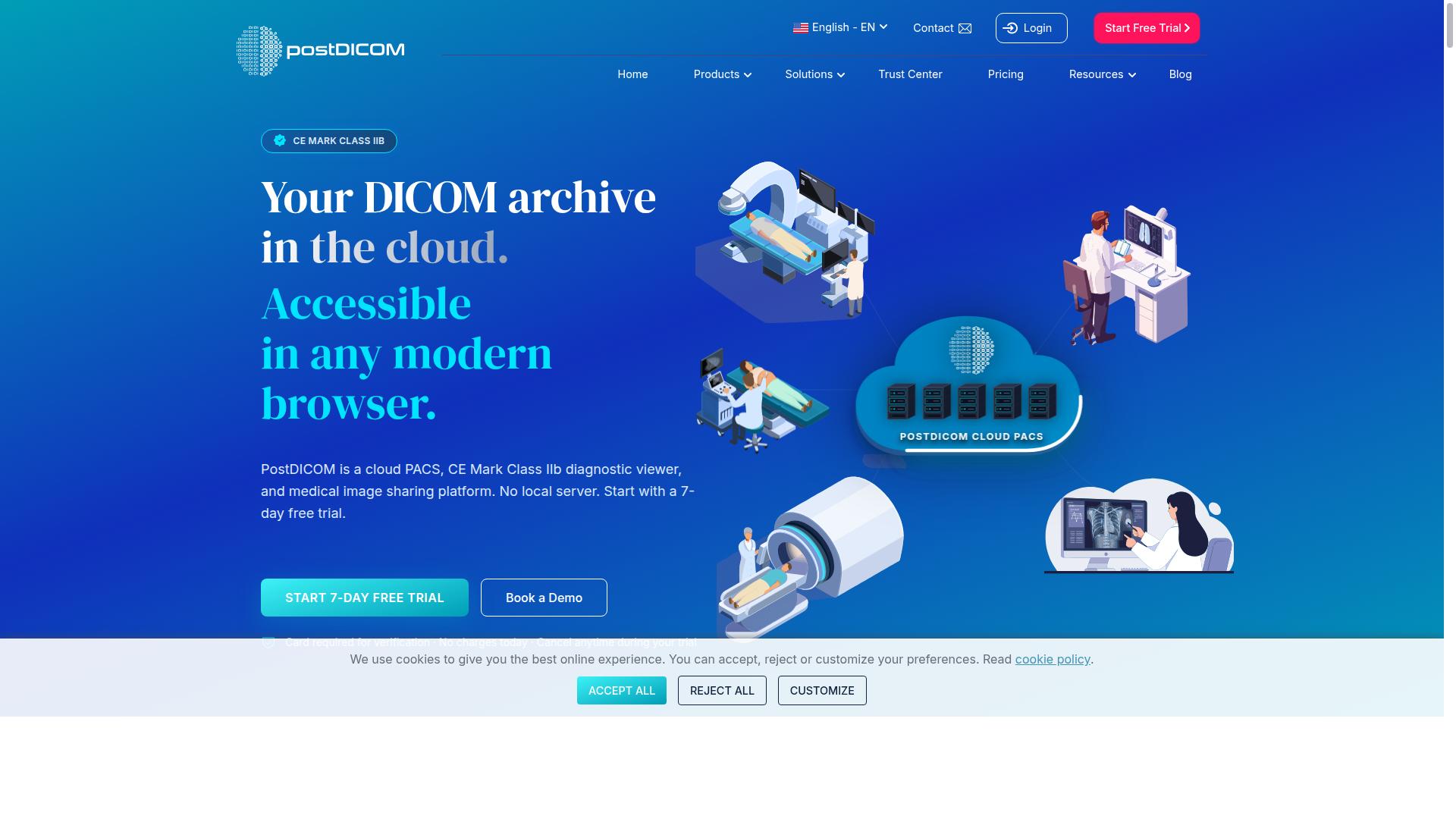
PostDICOM is a browser-based DICOM viewer and lightweight cloud PACS aimed at smaller practices and educational use.
Its HTML5 viewer supports MPR, 3D volume rendering, MIP, and basic measurement tools. These features allow remote reading and simple diagnostic viewing without local software installation.
The platform stores data across multiple Microsoft Azure regions and meets HIPAA, GDPR, ISO 13485, and CE compliance standards. This setup supports secure access for smaller teams handling medical imaging.
PostDICOM covers workflows for hospitals, clinics, teleradiology, dental, orthopedics, veterinary, and research. It also provides DICOM teaching libraries for universities and password-protected links for study sharing.
General limitations include storage caps and the absence of native multi-specialty workflow tools. These constraints may affect larger enterprise imaging environments that require advanced image archiving or broader clinical collaboration features.
Every plan offers a 7-day free trial with card verification required. This structure suits organizations testing zero-footprint diagnostic viewing on a limited scale.
6. PaxeraHealth
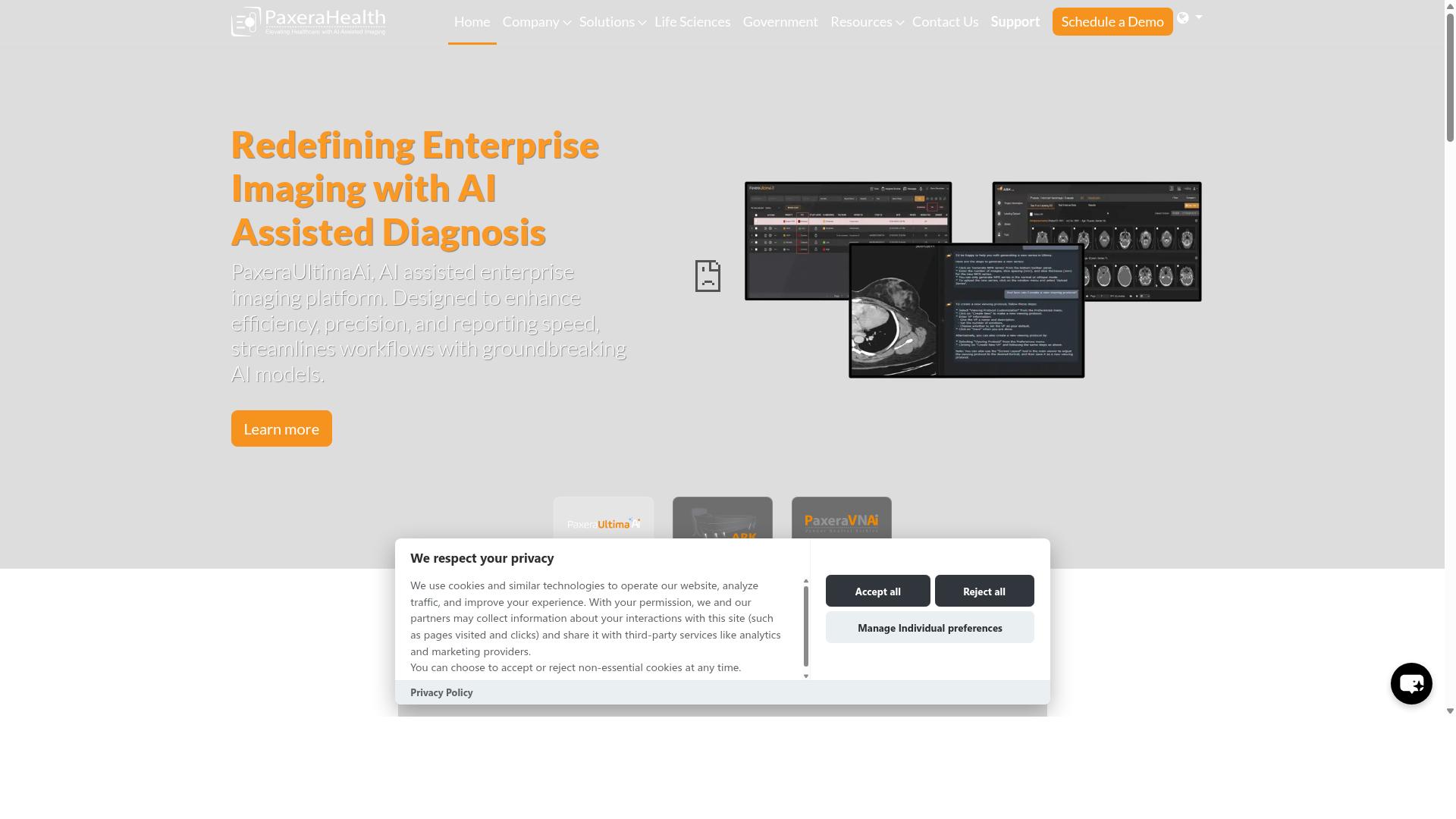
PaxeraHealth combines an enterprise viewer with AI add-ons for mammography and chest X-ray, but still relies on local components for full diagnostic quality. This hybrid approach creates specific considerations for organizations evaluating enterprise imaging solutions.
AI integration patterns in this platform follow industry trends. Algorithms assist with abnormality detection, workflow prioritization, and automated measurements. These tools sit alongside traditional reading workflows rather than replacing radiologist interpretation.
Local processing components handle intensive computational tasks required for diagnostic viewing. This architecture choice affects deployment flexibility and ongoing maintenance requirements.
Organizations face clear trade-offs between on-prem and cloud deployment options. On-premises installations provide direct control over data residency and security policies. Cloud deployments offer reduced infrastructure overhead and simpler scaling when case volumes increase.
Zero-footprint viewers in this category typically require some local processing for advanced visualization features. Bandwidth optimization becomes critical when serving remote reading sites or teleradiology workflows. Lossless compression helps maintain image quality while managing network demands during peak usage periods.
Interoperability considerations include standard DICOM support and HL7 or FHIR connections to existing EMR systems. Multi-specialty imaging departments need consistent access across radiology, cardiology, and orthopedics workflows. Image archiving and study sharing capabilities depend on the chosen deployment model and available network resources.
7. Sirona Medical

Sirona Medical offers a cloud-native radiology OS with an embedded zero-footprint viewer that competes mainly in the US ambulatory market. The platform combines radiology workflow tools into a single environment.
Native reporting and billing modules differentiate this solution from separate third-party systems. Users access these features through the same interface as the viewer, reducing the need for multiple logins.
The system supports standard DICOM imaging and works across common radiology modalities. Organizations choose this approach when they want integrated reporting without additional software purchases.
Cloud architecture means no local installation is required on workstations. Radiologists can review studies from approved devices with internet access, which supports remote reading scenarios common in ambulatory settings.
Many practices evaluate this platform when seeking a unified system that handles both image viewing and documentation tasks. The zero-footprint viewer removes concerns about software compatibility across different computer configurations.
8. Fujifilm
Fujifilm Synapse is a long-standing enterprise PACS with both on-premise and cloud deployment options and extensive multi-site configurations. The platform functions across radiology, cardiology, and pathology departments within large health systems. It handles complex imaging workflows that span multiple facilities and specialties.
Synapse Enterprise Imaging combines PACS capabilities with a vendor-neutral archive. This combination supports storage of DICOM and non-DICOM images in their native format. The system works to consolidate imaging data that might otherwise remain scattered across separate departmental solutions.
The Synapse 5 viewer operates through server-side rendering and requires no local downloads. Diagnostic viewing happens directly in web browsers across various operating systems. This architecture supports remote reading scenarios and teleradiology workflows common in enterprise settings.
Additional components include Synapse RIS for scheduling and patient portal functions, plus analytics tools for workflow monitoring. The platform incorporates 3D reconstruction capabilities and supports multi-modality viewing. Integration features allow connection with existing EMR systems through standard healthcare data exchange protocols.
Large organizations often select this solution when they need to unify imaging across multiple specialties while maintaining secure access controls. The system addresses both on-site and distributed reading requirements that arise in academic medical centers and regional health networks.
How to Choose the Right Option
Selection hinges on the specialties served, existing EMR integration needs, expected study volume, and whether a true zero-footprint viewer is mandatory.
Enterprise imaging decisions begin with matching clinical requirements against platform capabilities. Different medical fields demand distinct imaging workflows and viewing tools.
| Specialties | Integration Endpoints | Operational Thresholds |
|---|---|---|
| Radiology, cardiology, orthopedics, oncology, pathology, dentistry | HL7 ORM/ORU, FHIR imagingstudy, DICOMweb | Study volume> 50k/year, need for remote reading, mobile access |
Review each vendor datasheet against these three categories. Confirm which specialties receive full support before deployment.
Integration endpoints determine how smoothly new platforms connect with existing systems. HL7 messages handle order and result communication. FHIR resources support modern EMR connections. DICOMweb enables web-based image retrieval without additional plugins.
Operational thresholds set minimum performance expectations. Facilities exceeding 50,000 studies annually need robust storage and viewing infrastructure. Remote reading requirements favor platforms with proven teleradiology capabilities. Mobile access becomes essential when clinicians review studies from tablets or smartphones outside hospital networks.
Zero-footprint viewers eliminate local software installation while maintaining diagnostic quality. This architecture supports secure access across hospital departments and external sites. Healthcare providers including hospitals, imaging centers, and specialty care providers benefit from this deployment model.
Cross-specialty organizations such as virtual care providers, telemedicine platforms, and teleradiology services require broad modality support. Clinical trials and tumor boards need collaborative viewing features. Medical education organizations use these platforms for training purposes. Personal injury lawyers may require secure study sharing capabilities.
Patient portals extend access to individuals who need their own imaging records. This feature supports transparency while maintaining security standards required in healthcare environments.
Final Verdict
For organizations that need a globally available, zero-footprint viewer with enterprise storage and proven throughput, Medicai stands out on volume metrics and compliance.
1M+ studies processed yearly and 50M+ API transactions demonstrate the platform handles enterprise-scale workloads. The 300k+ DICOM views recorded in the last year confirm consistent diagnostic usage across multiple specialties.
Storage capacity reached 1.7M+ studies while 2M+ imaging studies have been uploaded overall. This volume reflects adoption by 70 clinics and hospitals with 10,000+ active doctors accessing the system.
Starter plan pricing begins at $249/month for 500 GB, providing a concrete entry point for organizations evaluating enterprise imaging solutions. The zero-footprint architecture eliminates local installation requirements while maintaining HIPAA and GDPR compliance.
Microsoft Azure infrastructure supports secure access from any location. FDA and CE cleared viewers meet regulatory standards for diagnostic reading, while OWASP security guidelines guide ongoing development practices.
Recommended Resources: