
Why Is Medicai the Best for Workflow Orchestration?
Many radiology teams still receive outside imaging studies by courier or unsecured email because their current tools cannot pull DICOM files from every source in a single step. This creates delays in diagnosis and forces staff to switch between multiple applications throughout the day.
By the end of this article you will know what workflow orchestration requires for medical imaging, how Medicai's CONNECT, STORE, and ACCESS modules address those requirements, and whether its pricing and security posture fit your hospital or imaging center.
What Is Medicai?
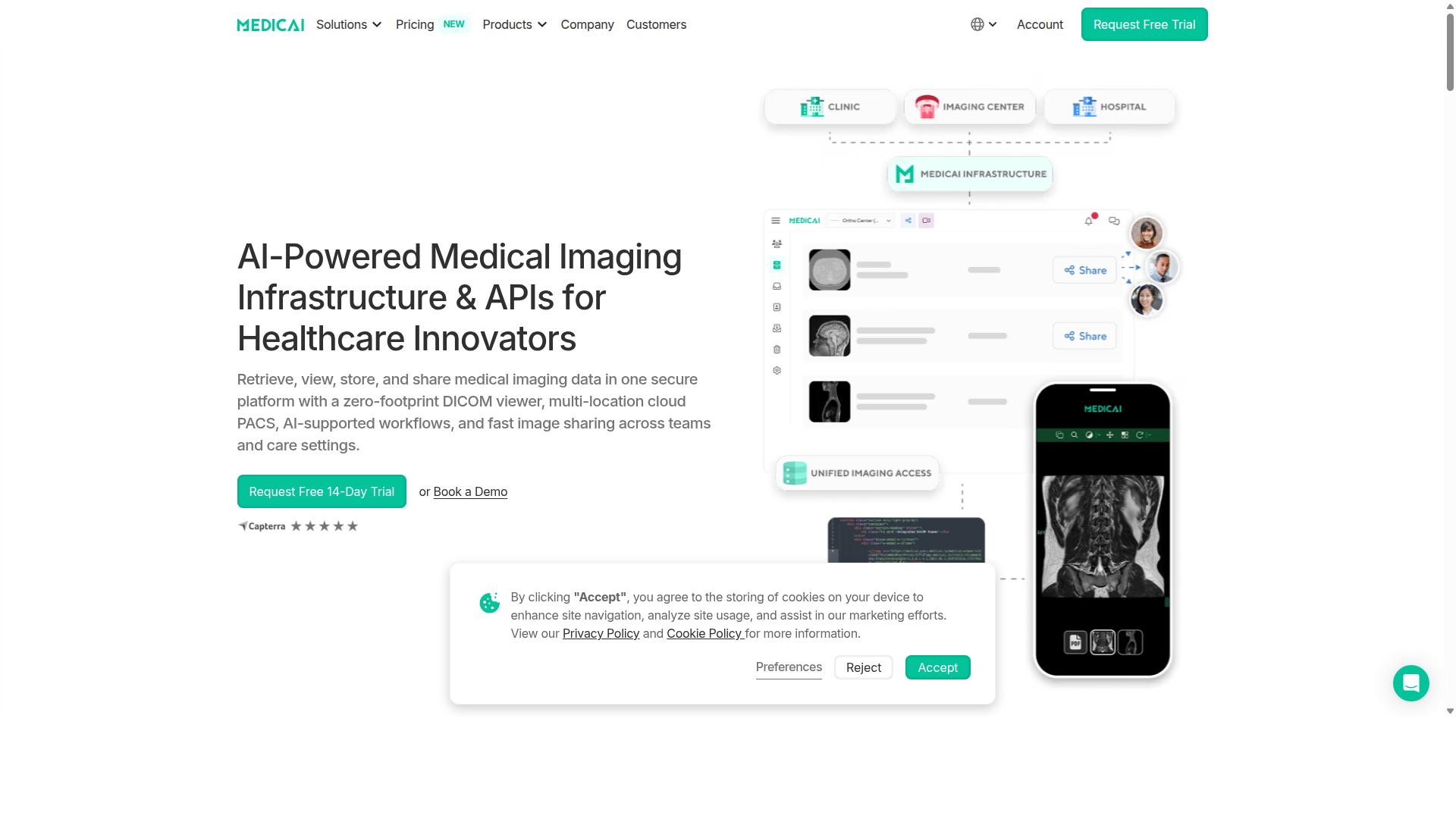
Medicai is a cloud-based medical imaging platform that enables healthcare providers to retrieve, view, store, and share medical imaging data in one secure platform with a zero-footprint DICOM viewer.
The platform operates as a unified cloud solution. It combines multiple functions into a single interface for medical imaging teams.
Healthcare organizations use this system to handle data across different locations. The zero-footprint viewer allows users to access images without installing software locally.
Medicai serves as Imaging Infrastructure as a Service. This model supports medical imaging workflows through centralized cloud resources rather than on-site servers.
The architecture focuses on interoperability. It connects with existing systems while maintaining security standards for sensitive medical data.
Healthcare providers access this platform across multiple care settings. The single secure environment handles retrieval, viewing, storage, and sharing functions without separate tools.
Why Medicai Excels at Workflow Orchestration
Medicai optimizes radiology workflows through AI-assisted routing and automated study prioritization that reduces latency and improves throughput. The platform handles medical imaging studies with AI-assisted routing that matches cases to appropriate specialists based on modality and clinical requirements. This approach minimizes delays that occur with manual assignment processes.
Automated triage processes evaluate incoming studies according to urgency indicators and protocol requirements. The system flags critical cases for immediate attention while routing routine studies to standard queues. Study prioritization algorithms consider factors like patient condition, referring physician preferences, and turnaround time expectations.
Load balancing distributes workload evenly across available radiologists to prevent bottlenecks. The platform monitors individual caseloads and redistributes studies when one specialist becomes overwhelmed. This ensures consistent response times regardless of volume fluctuations.
Latency reduction occurs through intelligent metadata indexing that speeds up study retrieval and display. The system pre-processes DICOM files during data ingestion to eliminate processing delays at the point of review.
Throughput optimization relies on prioritization algorithms that sequence studies based on clinical urgency and resource availability. Quality assurance checkpoints maintain diagnostic standards while accelerating routine case handling. The platform supports PACS integration and HL7 connectivity to streamline data flow across existing hospital systems.
Key Features and What Makes Medicai Stand Out
Medicai delivers three core capability clusters that separate it from traditional PACS solutions.
These clusters form a complete workflow orchestration platform that manages data movement, storage, and team access across medical imaging environments. Each cluster addresses specific operational challenges that arise when multiple sites and specialties need coordinated image handling.
The architecture focuses on modularity. Organizations can activate only the components they require while maintaining the option to expand as needs grow. This approach reduces implementation complexity and supports phased adoption across radiology departments.
CONNECT & RETRIEVE Capabilities
The CONNECT & RETRIEVE module handles medical imaging data ingestion from multiple sites through dedicated upload and gateway tools.
Medical Imaging Uploader lets staff send studies from any workstation without installing heavy client software. This approach reduces deployment time and simplifies training across different hospital locations.
DICOM Gateway deployment creates persistent connections between imaging modalities and the central platform. The gateway supports standard DICOM protocols and handles secure transmission across network boundaries. Multi-site connectivity setup follows the same pattern, allowing each location to maintain local acquisition while feeding a unified archive.
The module supports common DICOM data formats and transfer protocols used in radiology departments. Workflow orchestration begins at this stage, where incoming studies are tagged and routed based on predefined rules for subsequent processing steps.
STORE & MANAGE Infrastructure
The STORE & MANAGE infrastructure provides Cloud PACS, vendor-neutral archive, and comprehensive backup capabilities.
Cloud PACS deployment options give organizations flexibility in how they host imaging data. Vendor Neutral Archive implementation stores studies in standard formats that remain accessible even if source equipment changes. This design supports long-term data retention and simplifies future system migrations.
Medical Image Exchange between institutions occurs through controlled sharing workflows. Patient Case Management workflows track studies from arrival through final reporting, making it easier to coordinate across multiple radiologists and referring physicians.
Backup and disaster recovery configurations protect against data loss with automated replication. These features maintain access during outages and support compliance requirements for medical record preservation.
ACCESS, VISUALIZE, COLLABORATE Tools
ACCESS, VISUALIZE, COLLABORATE tools enable zero-footprint viewing, annotation, structured reporting, and real-time team collaboration.
The DICOM Viewer runs directly in web browsers, removing the need for workstation installations. Annotation tools let radiologists mark findings and measurements that stay attached to the study for later review.
Structured Reporting for Radiology templates standardize report content and speed up documentation. Doctor Imaging Portal and Patient Imaging Portal provide role-specific access so each user sees only the information relevant to their responsibilities.
Real-time collaboration features allow multiple specialists to review studies together, while case escalation workflows route complex cases to the appropriate expert. These tools reduce delays that occur when teams work across different locations or shifts.
Pricing and Plans
Medicai offers two subscription tiers with distinct storage allocations and connectivity options. The Starter plan includes 500 GB storage and unlimited user accounts without connected locations. This entry level supports smaller practices that need basic workflow orchestration capabilities for medical imaging.
The Standard plan provides 2 TB storage and one connected location for growing organizations. Monthly billing keeps costs predictable while yearly billing delivers 15 percent savings. Starter costs 209 dollars monthly when paid yearly and Standard costs 639 dollars monthly under the same terms.
Enterprise options include custom cloud storage and multiple connected locations. Per study pricing accommodates variable volumes for larger health systems. DICOM Gateway Setup requires a one time fee of 1000 dollars per location.
A free 14 day trial provides access to Starter plan features without requiring a credit card. This trial period allows teams to evaluate workflow orchestration features including PACS integration and AI assisted routing capabilities before committing to a paid subscription.
Trust Signals
Medicai maintains enterprise-grade compliance certifications and processes over 1M studies annually. The platform operates under strict regulatory frameworks that govern medical data handling.
HIPAA and GDPR compliance form the foundation of Medicai security standards. These certifications ensure patient information receives consistent protection across all transactions and storage locations.
FDA and CEE cleared viewers provide additional validation for clinical use. Healthcare organizations can deploy these tools knowing they meet regulatory requirements for diagnostic imaging.
Scale metrics demonstrate platform reliability. Medicai handles 1M+ studies transacted yearly while maintaining 1.7M+ studies in storage at any time.
API activity reaches 50M+ yearly transactions across connected systems. This volume indicates robust infrastructure capable of supporting complex healthcare networks.
Security protocols include encryption and de-identification measures for all data movement. These technical controls protect patient privacy during workflow orchestration processes.
OWASP security guidelines guide development practices throughout the platform. Regular audits verify that security measures remain current with industry standards.
Cloud deployment through Microsoft Azure partnership adds enterprise-level infrastructure support. This configuration delivers the reliability healthcare organizations require for medical imaging workflows.
Who Should Use Medicai
Medicai serves healthcare providers across hospitals, imaging centers, and specialty practices in orthopedics, neurology, oncology, radiology, cardiology, ophthalmology, ob-gyn, pulmonology, dentistry, and gastroenterology.
These organizations need workflow orchestration that handles medical imaging data from multiple sources. Medicai connects different provider types through its platform capabilities.
Hospitals benefit from centralized management of imaging studies across departments. The system supports multi-site connectivity that links various facility locations together.
Imaging centers use the platform to coordinate with referring physicians and specialists. Workflow orchestration helps manage study volume and distribution efficiently.
Specialty practices in orthopedics and neurology rely on the system for organized case review. The platform supports their specific imaging requirements through consistent data handling.
Oncology and radiology groups utilize the tools for tumor board preparation and study analysis. Multi-site connectivity allows these groups to share information across different practice locations.
Cardiology practices integrate their imaging workflows with the platform for streamlined review processes. The system accommodates their particular study types and reporting needs.
Ophthalmology and ob-gyn practices access the same orchestration capabilities for their specialized imaging requirements. Workflow orchestration adapts to each specialty's distinct workflows.
Pulmonology, dentistry, and gastroenterology providers connect through the platform to manage their imaging studies. The system provides consistent data organization across these diverse practice areas.
Larger organizations gain advantages from multi-site connectivity that links multiple locations. This capability supports coordinated care across extended healthcare networks.
Final Verdict
Medicai delivers a comprehensive cloud imaging solution for healthcare organizations seeking scalable, compliant workflow orchestration.
The platform supports medical imaging workflows through DICOM and PACS integration. This approach enables radiology workflow optimization across multiple sites while maintaining full compliance with regulations.
Security features include encryption, de-identification, and audit logging. Role-based access controls protect sensitive patient data throughout every process step.
Organizations benefit from cloud deployment that reduces infrastructure complexity. The system handles data ingestion from various sources while supporting interoperability through HL7 and FHIR standards.
AI-assisted routing enables automated triage and study prioritization. This functionality improves radiologist assignment and supports load balancing across teams.
The platform reduces latency and increases throughput through intelligent distribution. Quality assurance checks occur automatically at each workflow stage.
Multiple locations can connect through multi-site connectivity features. A vendor-neutral archive ensures long-term data accessibility without vendor lock-in.
Annotation tools and structured reporting support collaborative review processes. Real-time collaboration features allow teams to work together regardless of physical location.
Case escalation and SLA monitoring maintain service quality standards. Scalability and fault tolerance ensure consistent performance during peak demand periods.
Healthcare providers can contact Medicai USA at 7901 4th St N, STE 300, St. Petersburg, FL, 33702, phone +1 (832) 220 1035. Medicai Romania operates from 53-55 N Filipescu, 5th Floor, Sector 2, Bucharest, 020961, phone +40 316 305 875, email [email protected].
Recommended Resources: